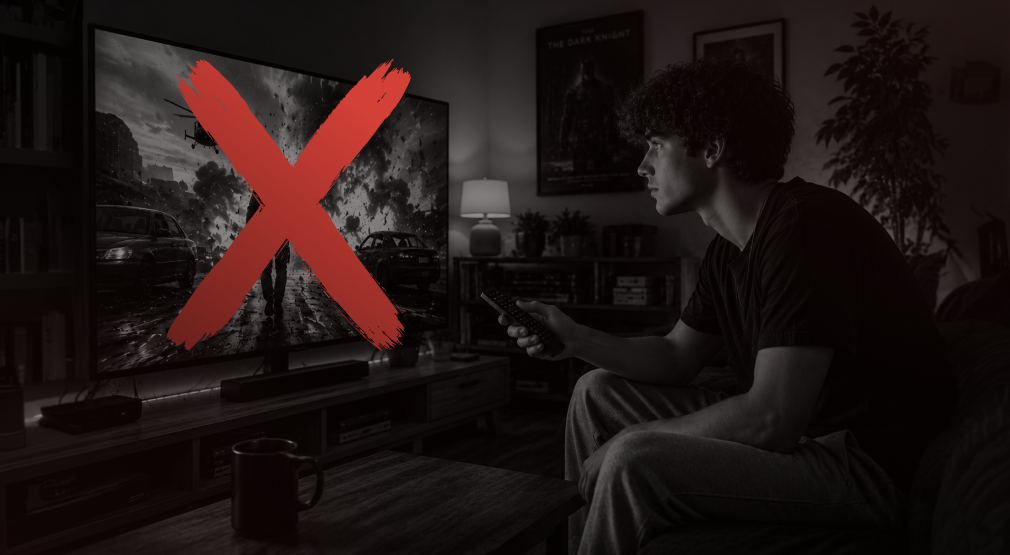
A channel-by-channel look at where 18–25-year-old attention actually lives, and why gaming environments deserve a planning line of their own.
Linear TV reaches a shrinking share of 18-25-year-olds with each passing year. Long-form video, short-form social, live streaming, audio, and in-game environments now split the attention that a single prime-time slot used to capture.
The right media plan treats each channel as doing a distinct job rather than searching for one universal replacement for TV.
Where 18–25 attention actually concentrates
Five core environments consistently show up where this age group already spends their daily time:
- In-Game (PC & Console): The primary interactive destination for the generation. Gen Z spends an average of 7.2 hours per week embedded in these virtual spaces, using them as their primary interactive communities.
- YouTube: The structural anchor for long-form discovery. Among US Gen Z social media users, 76.8% name it their primary home for long-form video.
- TikTok: The culture-driver for speed and vertical reach. 55.7% of Gen Z short-form viewers name it their definitive go-to platform.
- Twitch: The powerhouse for live community. It features a hyper-concentrated layout where roughly 70% of its daily active viewers sit squarely between 18 and 34.
- Spotify: The ultimate sonic companion layer. Gen Z now makes up roughly one-third of its total global user base.
None of these platforms alone accounts for a majority of this audience's time - making a multi-channel plan a necessity.
Why in-game advertising deserves its own line in the plan
Treating gaming purely as an experimental sponsorship add-on, instead of a premium media channel with its own audience logic and verified measurement, is the most common planning mistake when trying to reach Gen Z.
A media channel is defined by a pattern of attention, context, and measurement - not by the shape of the ad unit. Gaming environments have all three: repeating sessions, dedicated communities, and hyper-active attention.
Overwolf Ads is one of the largest examples of this shift. Ranked by Comscore as the #2 biggest US gaming property, the platform reaches over 113 million monthly gamers across thousands of top titles, including Fortnite, Minecraft, and League of Legends. Brands like P&G, KFC, and Universal Pictures run campaigns here to tap into true consumer dwell time rather than fleeting programmatic web clicks.
Crucially, because these ads are served natively inside desktop overlay applications without competing with traditional web page clutter, the baseline performance metrics outperform standard web video environments entirely. Overwolf Ads environments deliver an institutional average 90% ad viewability rate and an 85% video completion rate (VCR).
By placing ads exclusively during natural pauses - such as loading screens, post-match lobbies, or achievement moments - advertisers capture deep engagement without breaking a player's focus. It aligns with a universal advertising truth: interruption costs far more than it earns.
Case in Point: How Universal Pictures Captured Gamer Attention
When Universal Pictures needed to make Nobody 2 culturally unavoidable for hard-to-reach young adult audiences, they didn't just buy standard web banners. Working with Overwolf, they launched a multi-layered activation that dropped a world-first, custom NPC of Hollywood action star Bob Odenkirk directly into one of Fortnite’s most-played custom maps.
Supported by high-visibility media placements strategically timed to gameplay downtime, the campaign was shortlisted for four awards and took home Gold at The Drum Awards Americas 2026. It proved that when a campaign respects the player's time and aligns with their immediate gaming state, massive brand resonance naturally follows.
Matching the channel to the job
What this means for media planners
1. Stop looking for a single TV replacement
The modern 18–25 media mix is a web of specialized touchpoints. Build your plan by assigning each channel a distinct operational role: use YouTube and TikTok for cultural speed and visual discovery, layer on Spotify to capture non-competitive audio frequency during multi-tasking windows, and integrate gaming ads to anchor deep, uninterrupted attention during high-engagement gameplay downtime.
2. Solve the gaming fragmentation puzzle
The single biggest barrier to gaming adoption has always been scale and execution - buyers simply didn't want to manage dozens of disparate title sponsorships to stitch together a meaningful audience. Platforms like Overwolf Ads have solved this by consolidating the ecosystem, acting as a single, turnkey programmatic entry point across thousands of distinct game titles. Planners can buy via direct Deal IDs or PMPs through major DSPs like TheTradeDesk, Magnite, and OpenX with absolute ease.
3. Shift the focus to Clutter-Free Impact
Treat in-game advertising as a premium line item focused entirely on completed, high-impact attention, not as an experimental novelty. Because these ads run inside dedicated desktop apps - officially recommended as premium ad supply by benchmarking authorities like Jounce Media - they are completely insulated from typical web page clutter or ad blindness.
Planners should expect and audit for the exact same programmatic standards they use elsewhere in a premium video plan: verified viewability (averaging 90%), true video completion rates (averaging 85%), and verified brand-lift.
FAQs
Q: Should brands split budget across platforms or pick one?
A: It depends on the campaign goal. For broad reach, splitting your budget across platforms is ideal, as each captures distinct slices of daily attention (discovery, speed, and audio frequency) without competing for the exact same moment. However, if the objective is high-precision targeting - such as engaging younger audiences with zero wasted spend - concentrating your budget into a dedicated, high-impact channel like gaming can deliver far greater efficiency and impact.
Q: How is in-game advertising through Overwolf Ads programmatically different from a standard web buy?
A: Instead of standard web banners hidden behind scroll bars, Overwolf Ads operates at the software layer. Ads appear inside gaming desktop applications and companion environments where they are 100% in-view above the fold. Planners don't have to navigate fragmented developer deals; they can access this inventory programmatically using the same PMPs, DSPs, and verification partners (like Adelaide for attention scoring) they already trust.
Q: What metrics should brands track for in-game advertising campaigns?
A: Buyers should demand the identical verification standards used for a premium Connected TV (CTV) or digital video plan: Verified viewability, video completion rate (VCR), cost per completed view (CPCV), and third-party brand-lift studies.
Q: Does gaming-native advertising work for brands outside the gaming category?
A: Absolutely. Non-endemic FMCG, fashion, auto, and entertainment brands successfully use Overwolf Ads to reach young adults who are completely unreachable on traditional networks. For example, brands like Tropicana, Nissan, Crocs, and Clorox have successfully leveraged these in-game moments to capture the attention of Gen Z during natural, focused gameplay breaks.